
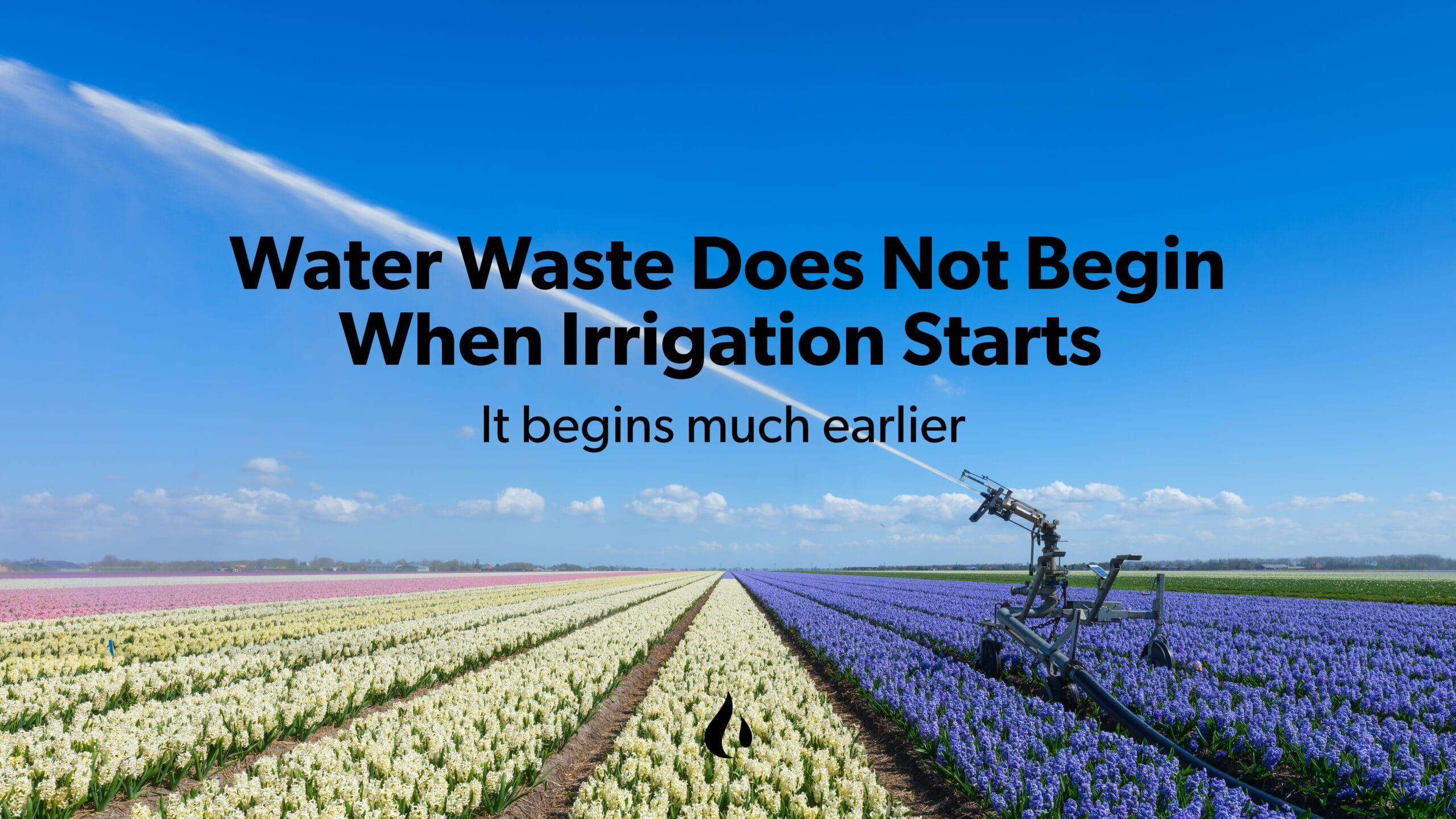
Water Waste Does Not Begin When Irrigation Starts
It begins much earlier
“The system works perfectly.”
That was the first response from a farmer when he was asked whether he had ever checked how efficient his irrigation system really was.
The motor pump was operating without any problems. The hose reel machines were completing their cycles. The crops were growing normally.
Everything seemed to be working.
Then the data revealed something unexpected.
By comparing the irrigation history with rainfall, the soil water balance, and the crop’s actual water requirements, it became clear that some irrigation cycles had been carried out while the soil still contained enough water.
There were no leaks.
There were no faults.
Water was not being wasted because the system was inefficient.
It was being wasted because some information was missing when the decision to irrigate was made.
And this is exactly where one of the most widespread forms of waste lies.
When people talk about water waste, they almost always think of a leak, a damaged pipe, or a system that is not working properly.
But the problem is often far less obvious.
Waste can also occur within a system that is working perfectly.
According to the FAO, approximately 70% of global freshwater withdrawals are used for agriculture. In this context, improving irrigation efficiency is one of the most effective ways to reduce water consumption without compromising productivity.
⚠️ When Consumption Becomes Habit
One of the most critical issues is management based on established routines.
For years, irrigating “for a few extra hours” or starting an irrigation cycle earlier has been seen as a form of security.
An understandable choice.
Experience teaches us that running out of water at the wrong time can compromise an entire season.
Today, however, the context has changed.
Rainfall is less predictable, temperatures fluctuate rapidly, and crop water requirements change continuously.
Continuing to irrigate according to the same pattern means risking the distribution of water when it is not actually needed.
The same principle also applies to industry.
Many processes continue to use the same parameters set years ago simply because “they have always worked”.
In both cases, the risk is the same.
Turning a habit into an automatic decision.
The problem, therefore, is not only how much is consumed.
It is understanding whether that consumption is truly necessary.
⚙️ The Hidden Cost of Water Used Inefficiently
When we talk about waste, water is naturally the first thing that comes to mind.
But every cubic metre distributed unnecessarily comes with many hidden costs.
In agriculture, this means more operating hours for the motor pump, higher fuel or energy consumption, greater system wear, and more time spent on management.
It can affect the soil water balance, the crop’s response, and, over the long term, maintenance costs as well.
The same principle applies in industry.
Inefficient water use can affect performance, production continuity, and energy consumption.
Water waste, therefore, is rarely an isolated problem.
It is almost always a sign that the decision-making process can be improved.
📊 From Habit to Data-Driven Management
For many years, having more water available meant working with greater peace of mind.
Today, this approach is no longer enough.
Irrigation management requires precision.
It is not enough to know that water has been distributed.
It is necessary to understand whether it was distributed at the right time, in the correct amount, and according to the crop’s actual needs.
To achieve this, different types of information must be combined.
Flow rate, pressure, consumption, and system performance show how the system is operating.
Weather conditions, crop development, soil characteristics, water balance, and satellite data indicate when to irrigate and when it is better to wait.
Technology does not make decisions.
It provides the tools to make better ones.
The farmer’s experience remains essential.
The difference is that today it can be supported by objective, continuously updated information.
Reducing waste does not mean irrigating less.
It means irrigating more precisely.
🌱 A Better Decision Is Worth More Than a Litre Saved
When discussing irrigation efficiency, people tend to think immediately of higher-performance pumps, more efficient sprinklers, or new technologies.
These are all important factors.
But often the real potential for improvement comes earlier.
It begins at the moment when the decision is made whether to irrigate, when to irrigate, and for how long.
Every decision made with more complete information can lead to more efficient use of water, energy, and time.
This is where data stops being a simple number and becomes an operational tool.
Conclusion
Water waste does not begin when we open a valve.
It begins when we make a decision without having all the necessary information.
Experience will continue to be the farmer’s most valuable asset.
But today, it can rely on an additional ally: data.
Because using less water does not mean irrigating less.
It means using every litre at the moment when it can deliver the greatest benefit.
More articles

TECH DROP: IRRIGATION 4.0
In this article you will find a brief analysis of how agriculture has changed with the advent of digitization, leading to reduced water consumption, higher crop yields, and significant reductions in energy and operational costs.

TECH DROP: ORGANIC 4.0
Italian organic enters the 4.0 era: between digital innovation and market challenges, sustainable agriculture seeks a new balance between technology, value and profitability.

TECH DROP: CARBON FOOTPRINT
Carbon Footprint and Stage V Engines: Technology and Sustainability Work Together. Learn how IdroMOP control units help reduce emissions, optimize performance, and make the most of every drop of fuel.

TECH DROP: HOW A IDROMOP PRODUCT IS BORN
How is a IdroMOP product developed?
From listening to real needs in the field to design, from internal testing to validation on real agricultural systems: a rigorous process based on standards, procedures, and reliability.

TECH DROP: THE EVOLUTION OF IRRIGATION
Hardware remains essential. But today, software and data make the difference. Real value emerges when field data becomes operational decisions through automation, real-time analysis, and remote management.

TECH DROP: WHAT WE LEARNED
11 years in the irrigation industry have taught us one thing: innovation begins with listening. Designing technology in the company is only part of the job. The real test always takes place in the field, alongside those who use the machines on a daily basis.

TECH DROP: AGRICULTURE AND THE FUTURE SEEN BY YOUNG PEOPLE
The future of agriculture is already here: more digital, more efficient, more competitive. Discover smart, practical solutions designed to truly make a real difference in the field.

TECH DROP: HOW TO MAKE YOUR IRRIGATION MACHINE SMART
Electronic control, sensors and connectivity transform a traditional irrigation machine into a smart system capable of generating data, monitoring performance and supporting more efficient operational decisions.

TECH DROP: HOW THE ROLE OF FARMERS IS CHANGING
Agriculture is changing: less reaction, more prevention. Data, monitoring, and digital tools are transforming the way fields are managed.